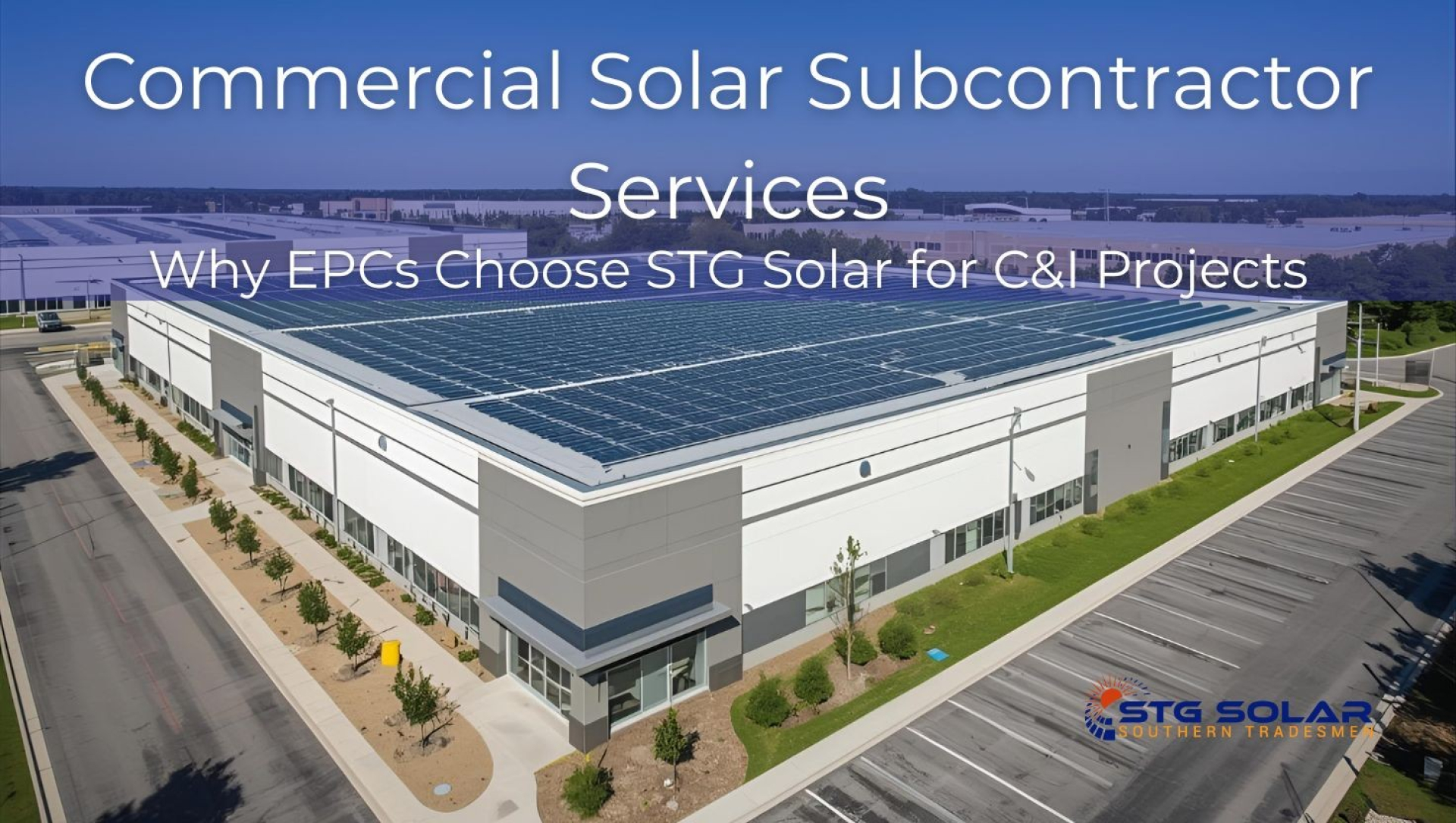
STG Solar is now expanding our proven utility-scale subcontractor services to support EPCs on commercial and industrial solar projects throughout Tennessee, North Carolina, South Carolina, Virginia, Georgia, Florida, Arkansas, Louisiana, Mississippi, Alabama, and Texas. After successfully delivering 1.79 gigawatts of solar installations as a trusted subcontractor to major EPCs since 2015, we're bringing the same self-performing excellence and technical capabilities to C&I projects across the Southeast.
Looking for a reliable electrical and mechanical subcontractor for your C&I solar projects? Talk to STG Solar's team to discuss how our self-performing capabilities can support your commercial solar development.
The C&I Subcontractor Challenge for EPCs
Commercial and industrial solar projects present unique subcontracting challenges that distinguish them from both residential installations and utility-scale developments. EPCs managing C&I projects need trade contractors who understand these distinctions and possess the specialized capabilities required for successful execution.
Technical Complexity Demands Specialized Expertise
C&I solar installations require sophisticated electrical and mechanical capabilities that exceed typical commercial construction trades. Integrating solar systems with existing facility electrical infrastructure, coordinating utility interconnections, managing structural constraints on commercial rooftops, and optimizing system performance for complex load profiles all demand specialized solar expertise.
EPCs cannot simply engage general electrical contractors who lack solar-specific experience. C&I solar projects require trade contractors with deep understanding of photovoltaic systems, inverter technology, energy storage integration, and solar-specific electrical codes and standards.
Quality Standards Cannot Be Compromised
EPCs stake their reputations on project quality and long-term performance. When subcontractors deliver substandard work—improper electrical connections, inadequate mounting systems, or poor workmanship—the EPC bears responsibility for system failures, performance shortfalls, and client dissatisfaction.
This accountability creates powerful incentives for EPCs to select subcontractors with proven track records, robust quality control processes, and genuine commitment to excellence. The lowest subcontractor bid becomes exponentially expensive when poor quality work requires remediation or causes long-term performance problems.
Schedule Reliability Affects Project Economics
C&I solar projects operate under tight schedules driven by client needs, utility interconnection deadlines, and financial incentive timing. Subcontractors who cannot maintain reliable schedules create cascading delays that affect project economics and client relationships.
EPCs need trade contractors who control their labor resources, manage material procurement effectively, and coordinate seamlessly with other trades to keep projects on schedule.
Safety Protocols Must Meet Stringent Standards
Commercial rooftop and ground-mount installations present significant safety challenges. EPCs cannot accept subcontractors with inadequate safety programs or poor safety performance records. A single serious incident can shut down projects, create liability exposure, and damage EPC reputations.
This reality makes safety performance a non-negotiable qualification criterion when selecting C&I solar subcontractors.
Why Self-Performing Subcontractors Deliver Superior Results
One of the most critical distinctions among solar trade contractors involves whether they perform work with their own crews or further subcontract to third parties. This difference fundamentally affects quality, accountability, and project outcomes.
The Sub-Subcontracting Problem
Many companies position themselves as solar subcontractors to EPCs but actually function as labor brokers who further subcontract installation work to third-party crews. This sub-subcontracting model creates multiple problems for EPCs:
Diluted Quality Control: When installation crews don't work directly for your subcontractor, quality standards become inconsistent. Sub-subcontractors may lack proper training, use improper techniques, or cut corners to maximize their profits.
Accountability Gaps: When problems arise, sub-subcontracting firms often claim issues resulted from their sub-tier contractors rather than accepting direct responsibility. This finger-pointing complicates problem resolution and leaves EPCs managing disputes between multiple parties.
Limited Oversight: Prime subcontractors have less direct control over sub-subcontractor work quality, safety practices, and schedule adherence than over their own employees.
Communication Breakdowns: Multiple organizational layers create communication inefficiencies. Technical questions or installation adjustments require coordination through intermediary parties rather than direct engagement with installation crews.
Service Continuity Problems: Sub-subcontractors often prove unavailable for warranty service, system troubleshooting, or future project phases, leaving EPCs without the continuity needed for long-term client support.
The Self-Performing Advantage
Self-performing subcontractors employ their own trained crews who work directly for the company. This approach delivers substantial advantages for EPCs:
Consistent Quality: When the same organization provides both project management and field execution, quality standards remain uniform across all work. Self-performing contractors cannot deflect responsibility for installation quality—they own every aspect of execution.
Direct Accountability: EPCs deal with a single point of contact fully responsible for all work. When issues arise, self-performing subcontractors resolve problems directly rather than coordinating with external parties.
Effective Communication: Direct access to installation crews streamlines technical coordination and problem-solving. EPCs can address questions or adjustments with the people actually performing the work.
Schedule Control: Self-performing contractors control their labor resources, eliminating uncertainties inherent in coordinating sub-subcontractor availability.
Long-Term Partnership: Installation crews remain available for warranty support, future project phases, and ongoing client service, providing the continuity EPCs need for lasting client relationships.
Safety Accountability: Self-performing contractors maintain direct oversight of all site safety practices, ensuring consistent adherence to safety protocols.
Comprehensive Trade Services for C&I Solar Projects
Commercial and industrial solar installations require coordinated electrical and mechanical expertise across multiple project phases. EPCs benefit from subcontractors who can self-perform all required trades rather than coordinating multiple specialized firms.
Electrical Contractor Services
Solar electrical work demands capabilities that extend well beyond standard commercial electrical installation:
System Design Support: Electrical engineering expertise to support system design, optimize electrical configurations, and ensure code compliance.
Panel and Combiner Installation: Expert installation of solar panels, combiner boxes, and DC electrical systems following manufacturer specifications and industry best practices.
Inverter Installation and Configuration: Proper inverter mounting, electrical connections, and system configuration to optimize performance and reliability.
AC Electrical Integration: Integration with facility electrical systems, including main service connections, distribution equipment, and utility interconnection points.
Medium Voltage Expertise: For larger C&I installations requiring medium voltage electrical work, specialized MV capabilities ensure safe, compliant installations.
Electrical Testing and Commissioning: Comprehensive testing protocols to verify system performance, safety, and compliance before final energization.
STG Solar holds unlimited electrical licenses throughout the Southeast, providing the credentials and capabilities EPCs require for commercial electrical work across all project scales.
Mechanical Contractor Services
The mechanical aspects of solar installation require equal expertise and precision:
Structural Assessment Support: Coordination with structural engineers to verify mounting system compatibility with existing structures.
Mounting System Installation: Expert installation of racking and mounting systems designed for specific roof types or ground conditions, following engineered specifications.
Rooftop Installation Expertise: Specialized techniques for various commercial roofing systems—TPO, EPDM, modified bitumen, metal roofs—that preserve roof integrity and maintain existing warranties.
Ground-Mount Systems: Complete mechanical installation for ground-mount arrays, including foundation work, pile driving, and structural assembly.
Waterproofing and Flashing: Proper sealing and flashing around all roof penetrations to maintain building envelope integrity.
Equipment Installation: Mechanical installation of all system equipment including inverters, transformers, and associated infrastructure.
Battery Energy Storage System (BESS) Integration
As C&I projects increasingly incorporate energy storage, EPCs need subcontractors capable of complete BESS integration:
Battery System Installation: Expert installation of battery storage systems following manufacturer specifications and safety protocols.
Electrical Integration: Complex electrical work to integrate battery systems with solar arrays and facility electrical infrastructure.
Control System Programming: Configuration of battery management systems and integration with facility energy management systems.
Safety Systems: Installation of required safety systems including fire suppression, ventilation, and emergency shutdown capabilities.
Quality Standards That Mirror Utility-Scale Projects
STG Solar's expansion into C&I subcontracting brings utility-scale quality standards to commercial projects. The disciplines, processes, and performance expectations that major EPCs demand on large utility projects apply equally to every commercial installation we undertake.
Rigorous Quality Control Processes
Quality doesn't happen by accident—it results from systematic processes and unwavering commitment:
Detailed Work Planning: Comprehensive pre-construction planning that identifies potential issues before crews arrive on site.
Trained Installation Crews: All field personnel receive ongoing training in installation techniques, equipment handling, and quality standards.
In-Process Inspections: Regular quality inspections throughout installation to identify and correct issues immediately rather than discovering problems during final testing.
Testing and Verification: Comprehensive testing protocols verify that all systems meet performance specifications and safety standards before handover.
Documentation: Complete as-built documentation, test results, and warranty information provided for every project.
Safety as a Core Value
Safety performance separates professional contractors from companies that merely talk about safety commitment. STG Solar maintains comprehensive safety programs that protect workers, clients, and project sites:
OSHA Certified Personnel: All site personnel hold relevant OSHA safety certifications appropriate for commercial solar work.
Site-Specific Safety Plans: Customized safety plans for each project addressing specific site hazards and safety requirements.
Daily Safety Briefings: Regular safety meetings ensure all crew members understand daily safety priorities and protocols.
Safety Equipment and PPE: Proper personal protective equipment and safety systems for all site personnel, with strict enforcement of usage requirements.
Incident Prevention: Proactive hazard identification and mitigation prevents incidents rather than simply reacting to safety events.
Safety Performance Tracking: Comprehensive safety metrics and performance tracking demonstrate genuine safety culture rather than superficial compliance.
Our commitment to safety reflects our values and our understanding that nothing matters more than ensuring every crew member returns home safely at the end of each day.
Regional Expertise Across the Southeast
C&I solar development varies significantly across different markets due to regulatory frameworks, utility requirements, climate considerations, and local construction practices. STG Solar's regional presence throughout the Southeast provides EPCs with local expertise and responsive support across multiple markets.
Multi-State Electrical Licensing
Electrical licensing requirements vary by state, and commercial solar projects require proper credentials in each jurisdiction. Our unlimited electrical licenses throughout Tennessee, North Carolina, South Carolina, Virginia, Georgia, Florida, Arkansas, Louisiana, Mississippi, Alabama, and Texas ensure compliance with state-specific requirements.
Utility Interconnection Experience
Each utility has unique interconnection requirements and processes. Our experience working with Southeast utilities helps navigate interconnection applications, coordinate technical requirements, and resolve utility-related issues efficiently.
Climate-Appropriate Design and Installation
The Southeast's climate—hot summers, high humidity, hurricane exposure in coastal regions—affects equipment selection and installation practices. Our regional experience ensures installations account for climate realities and incorporate appropriate design elements for local conditions.
Local Code Knowledge
Building codes, electrical codes, and solar-specific requirements vary across jurisdictions. Our experience working throughout the Southeast provides familiarity with local code requirements and relationships with local inspectors and authorities having jurisdiction.
Supporting EPC Success on C&I Projects
EPCs choose subcontractors based on their ability to support overall project success. STG Solar understands that our role extends beyond simply completing assigned work—we function as true partners in helping EPCs deliver successful projects to their clients.
Responsive Communication
Effective project coordination requires clear, timely communication. Our project management teams maintain regular communication with EPC project managers, respond promptly to questions and concerns, and proactively identify potential issues before they affect project schedules or budgets.
Technical Collaboration
Complex C&I projects often require technical problem-solving and design adaptation as site conditions become fully understood. Our electrical and mechanical expertise enables collaborative problem-solving with EPC teams to develop optimal solutions to technical challenges.
Schedule Coordination
We understand that our work must coordinate seamlessly with other trades and project milestones. Our project planning processes account for coordination requirements, and our self-performing model provides the schedule control needed to maintain reliable timelines.
Quality Documentation
EPCs need comprehensive documentation for client deliverables, warranty administration, and operations and maintenance planning. We provide complete as-built documentation, testing records, equipment warranties, and operating information for all projects.
The STG Solar Difference for C&I Projects
When EPCs choose STG Solar as their electrical and mechanical subcontractor for C&I solar projects, they partner with a company that brings:
Proven Utility-Scale Experience: Since 2015, we've delivered 1.79 gigawatts of solar installations as a trusted subcontractor to some of the largest EPCs in the solar industry. The same quality standards and execution excellence that major utility projects demand apply to every commercial installation.
True Self-Performing Capabilities: Our own electrical and mechanical crews—not sub-subcontractors—perform all work. EPCs gain the quality control, accountability, and reliability advantages that only self-performing contractors can provide.
Comprehensive Technical Capabilities: Full electrical and mechanical capabilities across all C&I project types—rooftop installations, ground-mount systems, and battery energy storage integration. EPCs can engage a single subcontractor for all required trades rather than coordinating multiple specialty firms.
Unwavering Safety Commitment: OSHA-certified personnel on every project, comprehensive safety programs, and strong safety performance records demonstrate genuine safety culture.
Regional Coverage and Local Expertise: Operations throughout the Southeast provide EPCs with responsive local support backed by regional expertise and multi-state licensing credentials.
Long-Term Partnership Approach: We view subcontractor relationships as long-term partnerships, not transactional engagements. EPCs can count on consistent quality and reliable support across multiple projects over many years.
Getting Started with C&I Subcontractor Services
EPCs planning commercial and industrial solar projects throughout the Southeast can benefit from discussing project requirements with our team. We provide:
Capabilities Overview: Detailed information about our electrical and mechanical services, technical capabilities, and experience with similar project types.
Project Assessment: Review of project requirements to confirm our capabilities align with specific project needs.
Qualification Documentation: Complete qualification packages including licensing credentials, insurance certificates, safety statistics, and reference projects.
Competitive Proposals: Detailed proposals that clearly define scope, schedule, deliverables, and pricing.
Technical Collaboration: Engineering and technical expertise to support project planning and design optimization.
Ready to discuss your C&I solar subcontracting needs? Contact STG Solar to learn how our self-performing electrical and mechanical capabilities can support your commercial solar projects across the Southeast.
**Disclaimer:** The information provided in this article is for general educational purposes only and should not be considered professional engineering, financial, or legal advice. Solar system design and implementation require site-specific engineering analysis that accounts for each facility's unique structural, electrical, and operational requirements. Before making any decisions about solar installation, we strongly recommend consulting with qualified solar engineers and designers who can properly assess specific situations. Every commercial facility has unique structural, electrical, and operational characteristics that must be properly evaluated by qualified professionals before proceeding with solar installation. Factors including roof structural capacity, electrical system compatibility, local code requirements, utility interconnection specifications, and site-specific conditions require professional engineering analysis.