The Solar Blog
Why BESS Construction Is Harder Than Solar
Monday, November 23, 2026On paper, a battery energy storage site looks simpler than a solar farm. There are no thousands of piles to drive and no rows of trackers to align. The battery containers arrive on trucks mostly built, and the footprint is a fraction of a solar field.
Anyone who has built one knows better. A BESS site packs more energy, more electrical work and more code requirements into a smaller space than any solar farm. The margin for error is thinner, the inspections are tougher and the schedule pressure is higher. For EPCs and developers moving into storage, understanding why is the first step to picking the right crew.
Quick Summary
- BESS sites store a large amount of energy in a small area, so fire and electrical codes are much stricter than on solar.
- NFPA 855, NEC Article 706 and UL 9540 and 9540A shape almost every design and field decision.
- Most BESS field work is electrical: cabling, terminations, medium voltage, grounding and communications.
- Battery revenue starts at commercial operation, so delays cost owners money fast.
- Ask any BESS subcontractor about codes, self-performed scope, testing and safety before you sign.
A Battery Site Is an Electrical Job First
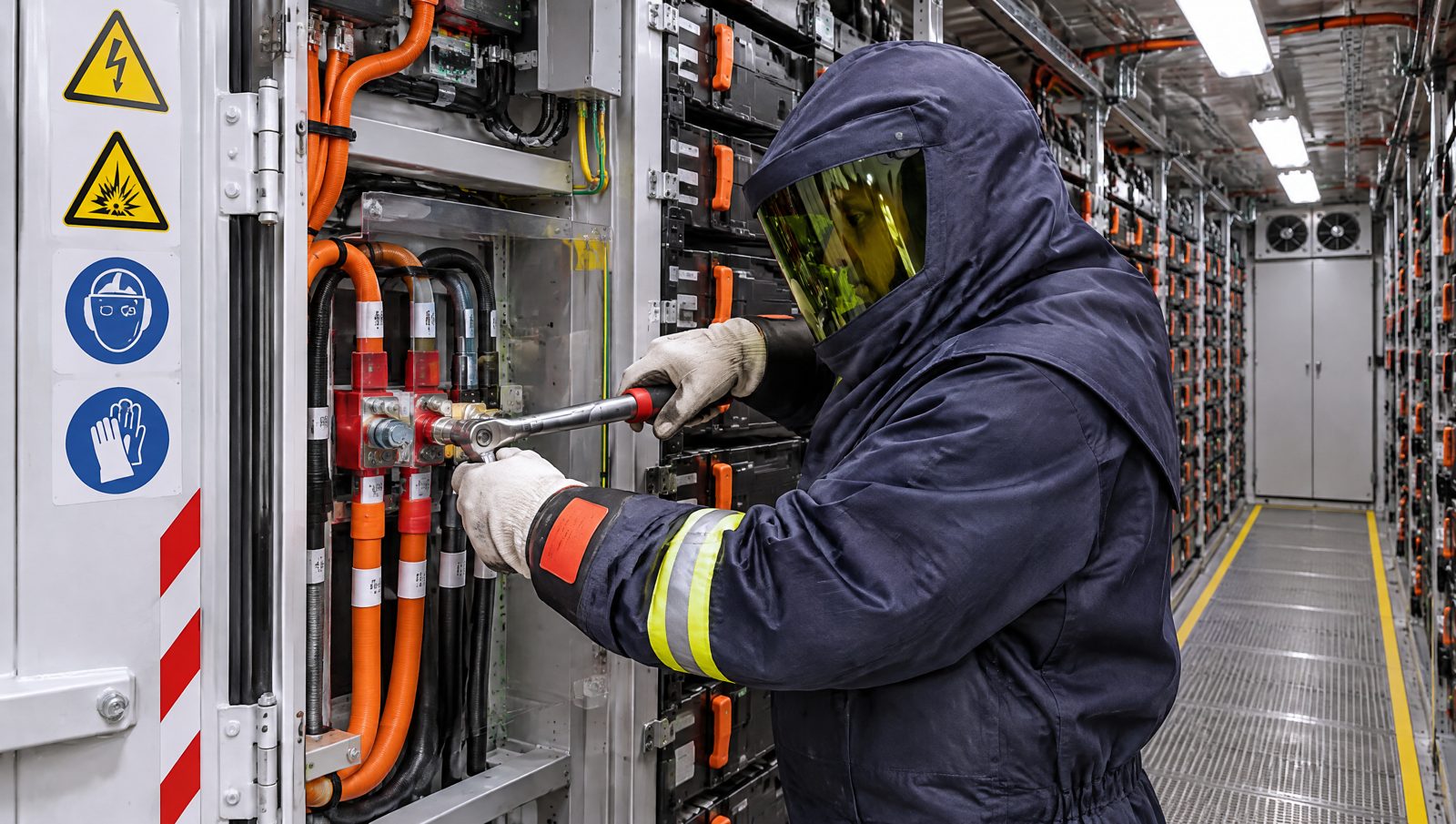
On a solar farm, a big share of the labor is mechanical: piles, racking, trackers and module installation. On a BESS site, that balance flips. The containers, racks and battery modules are built and tested in a factory. What's left for the field crew is mostly electrical.
That electrical work includes:
- Grounding grids and bonding for every container and enclosure
- DC cabling between battery enclosures and the power conversion systems
- AC cabling from the inverters to the step-up transformers
- Medium voltage collection back to the substation
- Auxiliary power for HVAC, fire detection and controls
- Fiber optic and copper communications for the battery management system, plant controller and SCADA
Every termination counts. A loose connection on a solar string might cost a little production. A loose connection on a battery system can create heat in a place that's built to hold a lot of stored energy. That's why torque checks, labeling and documentation matter more on storage than almost anywhere else in the energy world.
The Codes Are Stricter, and They Change Often
Solar farms follow the National Electrical Code and local building rules. BESS sites follow those too, plus a stack of standards written specifically for stored energy. Here are the ones every crew on a storage project needs to know.
NFPA 855
NFPA 855 is the standard for installing stationary energy storage systems. It covers spacing between units, separation from buildings and property lines, fire detection and suppression, explosion control, and access for firefighters. It also calls for a commissioning plan and an emergency response plan. Many states and local fire departments adopt it directly or through the International Fire Code.
NEC Article 706
Article 706 of the National Electrical Code covers energy storage systems. It sets rules for disconnects, labeling, overcurrent protection and circuit sizing. It works alongside Article 705 for interconnected power sources and Article 480 for storage batteries.
UL 9540 and UL 9540A
UL 9540 is the safety listing for the complete energy storage system. UL 9540A is a test method that shows how a battery system behaves if one cell goes into thermal runaway, and whether fire spreads to nearby units. The results often decide how far apart containers have to sit on site.
NFPA 70E
NFPA 70E covers electrical safety in the workplace. On a BESS site, crews work around DC systems that can't simply be switched off, since the batteries themselves hold the energy. Lockout and tagout, arc flash protection and safe work procedures all have to account for that.
These standards get updated on a regular cycle, and different jurisdictions adopt different editions. A crew that builds to the wrong version can fail inspection on work that looked fine. The engineer of record sets the design, but the field crew has to understand why each spacing, label and clearance is there.
Fire Safety Shapes the Whole Site
The biggest difference between solar and storage is fire risk. Lithium-ion batteries are safe when they're built and maintained right, but a damaged or faulty cell can overheat and set off a chain reaction called thermal runaway.
That risk shapes everything on a BESS site:
- Container spacing based on fire testing results
- Gas detection and explosion control in enclosures
- Fire alarm and suppression systems tied into the controls
- Access roads and clear zones for fire trucks
- Emergency response plans shared with the local fire department
For the field crew, this means more inspections and more coordination. Fire marshals often want to walk the site, review the emergency plan and witness system tests. A crew that understands the fire side of the job keeps those visits short and successful.
The Schedule Pressure Is Higher
A solar farm earns money by producing energy over decades. A battery earns money by responding fast: storing power when prices are low and selling it back when prices spike or the grid needs support. In markets like ERCOT in Texas, those price swings can be large, so every day without the battery in service is lost revenue.
That puts a hard deadline on construction. Utility witness tests, interconnection dates and commercial operation targets are set months ahead and are difficult to move. If cabling runs late, or a failed test needs rework, the whole energization chain slips.
The fix is a crew that self-performs the electrical work, tests as it goes and doesn't hand off a mess to the commissioning team. Learn how we close that gap on our solar and BESS commissioning page.
Solar Plus Storage Adds Coordination
Many new battery projects sit next to solar farms. The two often share a substation, an interconnection and sometimes a collection system. That saves money, but it means two scopes working on one site.
Coordination problems show up fast:
- Crews competing for the same laydown areas and access roads
- Medium voltage tie-ins that need outages on a live solar site
- Plant controllers that must manage both solar and storage output
- Separate commissioning steps that still share one utility witness date
A contractor with deep solar experience already knows how solar farms are built and energized. That makes the storage tie-in smoother, and it keeps the solar side producing while the batteries go in.
What to Ask a BESS Subcontractor Before You Sign
If you're hiring a subcontractor for a storage project, these questions will tell you a lot:
- What part of the scope do you self-perform? Look for in-house electricians for DC, AC, medium voltage and fiber work, not a chain of lower-tier subs.
- Which codes do your crews work to? They should name NFPA 855, NEC 706 and NFPA 70E without looking them up.
- How do you document terminations and torque? Ask to see a sample record.
- How do you test before handoff? Insulation resistance, continuity and communications checks should happen as work is finished, not all at the end.
- What's your safety program? Ask about DC lockout procedures and arc flash training.
- How many crew members can you put on site, and how fast? Storage schedules leave little room for slow mobilization.
How STG Solar Builds Battery Storage
STG Solar has installed 1.79 gigawatts of utility scale solar since 2015 across more than 64 projects. Our crews self-perform electrical, mechanical, medium voltage and fiber optic work, which is the core skill set a battery site demands.
We can take the full electrical scope on a BESS project or add crews to support yours. See our BESS Systems page, or read about our BESS construction work in Houston, TX.
Frequently Asked Questions
Is BESS construction more expensive than solar construction?
Per acre, usually yes, because a battery site holds far more electrical equipment and code-driven safety systems in a small area. Per project, costs depend on size, equipment and site conditions.
How long does it take to build a BESS site?
It depends on the size and design. Once equipment arrives, the electrical work, testing and commissioning usually set the pace. Utility interconnection dates often decide the final schedule.
Can a solar contractor build battery storage?
A solar contractor with strong self-performed electrical, medium voltage and fiber crews already has most of the skills. The added pieces are battery-specific codes, fire safety and DC safety procedures.
Who designs the BESS site layout?
The engineer of record designs the site based on the battery maker's requirements, UL 9540A results, NFPA 855 and local codes. The construction crew builds to that design and flags any field conflicts.
Build Storage With a Crew That Knows the Difference
Battery storage isn't a smaller solar farm. It's a denser, stricter and faster job, and it rewards crews that respect the details. If you're planning a storage project, or adding batteries to a solar site, pick a contractor that has built at scale and does its own electrical work.
Contact STG Solar to talk about your next BESS project.